
The Sunshine Act requires health care companies to report meals provided to physicians, physician assistants and nurse practitioners, among others. Each meal must have an assigned, per-person value and tie back to the person who received it.
Tracking these details can be challenging during group events such as seminars, workshops and conferences. Thankfully, ordering corporate catering can make reporting these meals more manageable. Learn about the Sunshine Act meal limits and how a reliable corporate caterer can ease reporting.
What Is the Sunshine Act?
The Sunshine Act, or the Physician Payments Sunshine Act opens in a new window, is a U.S. law designed to increase transparency in the health care industry. As part of the Affordable Care Act, PPSA requires applicable manufacturers and group purchasing organizations to report payments or items of value given to:
- Physicians — doctors of medicine, surgeons, podiatrists, dentists, clinical psychologists, optometrists, chiropractors and osteopathic practitioners
- Physician assistants
- Nurse practitioners
- Clinical nurse specialists
- Certified registered nurse anesthetists
- Certified nurse-midwives
- Teaching hospitals
Who Must Report Under the Sunshine Act?
Reporting requirements apply to applicable manufacturers and GPOs.
Applicable manufacturers are companies operating in the U.S. opens in a new window that produce drugs, medical devices, biologicals or medical supplies that are eligible for reimbursement by Medicare, Medicaid or the Children’s Health Insurance Program. To qualify, drugs and biologicals must require a prescription or a physician’s authorization, and devices must require FDA premarket approval or notification. Distributors or wholesalers that hold title to these products — and companies under common ownership with a primary applicable manufacturer — also qualify when they support the life cycle of covered products.
GPOs are U.S.-based entities that purchase, arrange for or negotiate the purchase of these same covered products.
Exemptions apply to:
- Companies that generate less than 10% of their total revenue from covered products.
- Companies without a U.S. presence.
- Raw material or component manufacturers.
- Hospitals or labs that produce products solely for their patients.
What Must You Report and Where?
Since the Sunshine Act treats meals as items of value, your organization must track and report any qualifying meal provided.
When reporting, you will need to specify:
- Who received the meal, including their name, business address, specialty, National Provider Identifier and state license number.
- How much it was worth in dollars.
- The date of receipt.
- The type of payment involved.
- What it was for.
All these details are available in a public database called Open Payments opens in a new window, managed by the Centers for Medicare and Medicaid Services. If you fail to report under the Sunshine Act meal guidelines, you may face a fine of $1,000 to $10,000 for each unreported payment. The maximum fine for all unreported items in a year is $150,000. If you knowingly fail to report, fines range from $10,000 to $100,000 per violation, with a maximum annual penalty of $1 million.
Current Meal Reporting Guidelines for the Sunshine Act
To fully understand the Sunshine Act and meal limits for the health care industry, you should know what meals you must report and when.
Reportable Meals
Most meals provided to covered recipients in a professional setting are reportable, including:
- Breakfast deliveries for teams and early morning meetings.
- Catered office lunches for work groups and departments.
- Sandwiches for lunch-and-learn sessions.
- Boxed meals for meetings, seminars or conferences.
- Gift snack baskets.
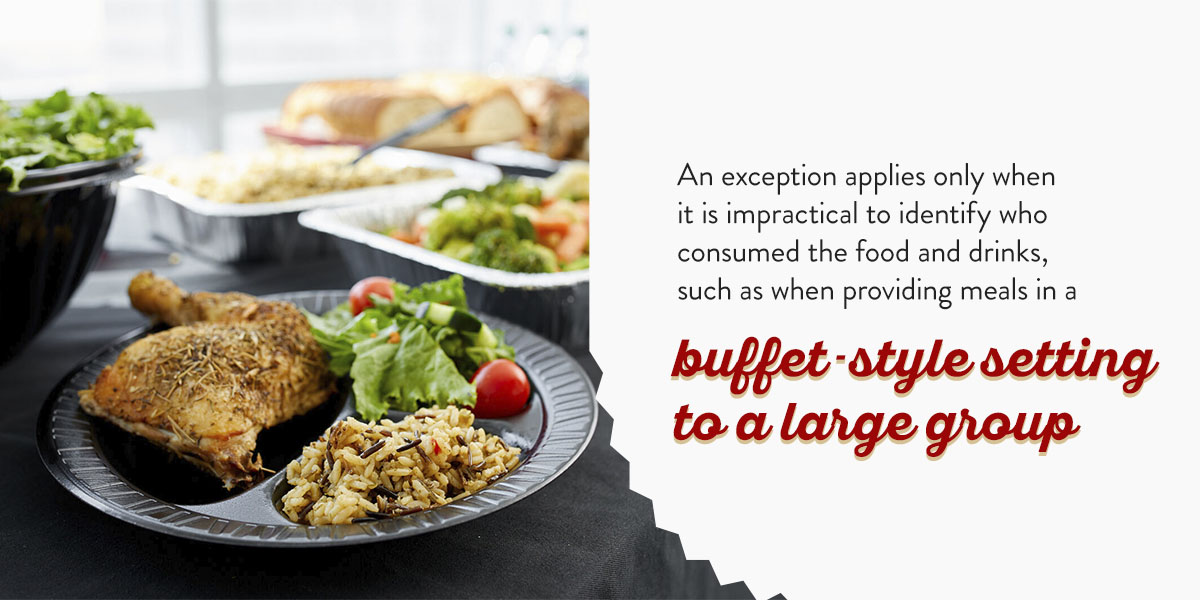
An exception applies only when it is impractical to identify who consumed the food and drinks, such as when providing meals in a buffet-style setting opens in a new window to a large group. But if you can establish identities, even at large-scale events, you must allocate and report the total cost across attendees.
Reporting Thresholds and Timelines
Each year, the CMS updates the thresholds opens in a new window that manufacturers and GPOs must follow, adjusting them based on the consumer price index.
In 2026, you need to report meals costing more than $13.82, as well as lower-cost meals once their combined annual value exceeds $138.13 per recipient. The deadline for submitting reports to the CMS is the 90th day of each calendar year, covering the previous year’s data. CMS publishes reports annually on Jan. 30.
Other Reporting Exemptions
There are other exemptions to the Sunshine Act reporting requirements. Applicable manufacturers and GPOs do not report meals provided to covered recipients whom they employ, and if the covered recipient receives them purely as a patient, not as a health care provider.
State Considerations
While the Sunshine Act overrides state laws for identical information disclosure, local regulations may still impose strict limits. Companies must therefore regularly review specific state requirements to ensure compliance. These seven states, plus Washington, D.C., have laws similar to the Sunshine Act:
- California
- Connecticut
- Louisiana
- Massachusetts
- Minnesota
- Nevada
- West Virginia
Given the detailed Sunshine Act reporting requirements and potential penalties, having a structured system for ordering and tracking meals is paramount. Partnering with an experienced corporate caterer can help you confidently comply with the Sunshine Act.
How Apple Spice Catering Can Help
You won’t have to worry about losing track of meals when you order from us.
- Individually packaged meals: We pack every meal separately, with the entrée, sides and extras contained in one clearly assigned order. There are no shared trays, so you always know what everyone received.
- Named labeling for every order: Whether you order five or 5,000 sandwiches, you can label each meal with the recipient’s name, making on-site distribution simple and reporting straightforward.
- Online ordering system: You can collect names, meal selections, quantities and costs in one place and save digital receipts that are easier to reference when it is time to report to the CSM.
- Flexible handling of special requests: At Apple Spice Catering, we fulfill dietary needs and individually mark custom orders. Every recipient receives what they wanted and no one will want to switch, which complicates tracking.
Your Catering Partner in Compliance and Convenience

We have been delivering meals to companies since 1988, building a reputation for reliability, consistency and service you can count on. What started in Salt Lake City has grown into a network of over 30 locations across the country.
Regardless of where you order, you can expect the same high standard. We prepare every meal fresh and deliver it directly from our kitchens. You will eat on time, every time. We also accommodate last-minute and specific dietary needs.
Browse our menus and order your meals online today.